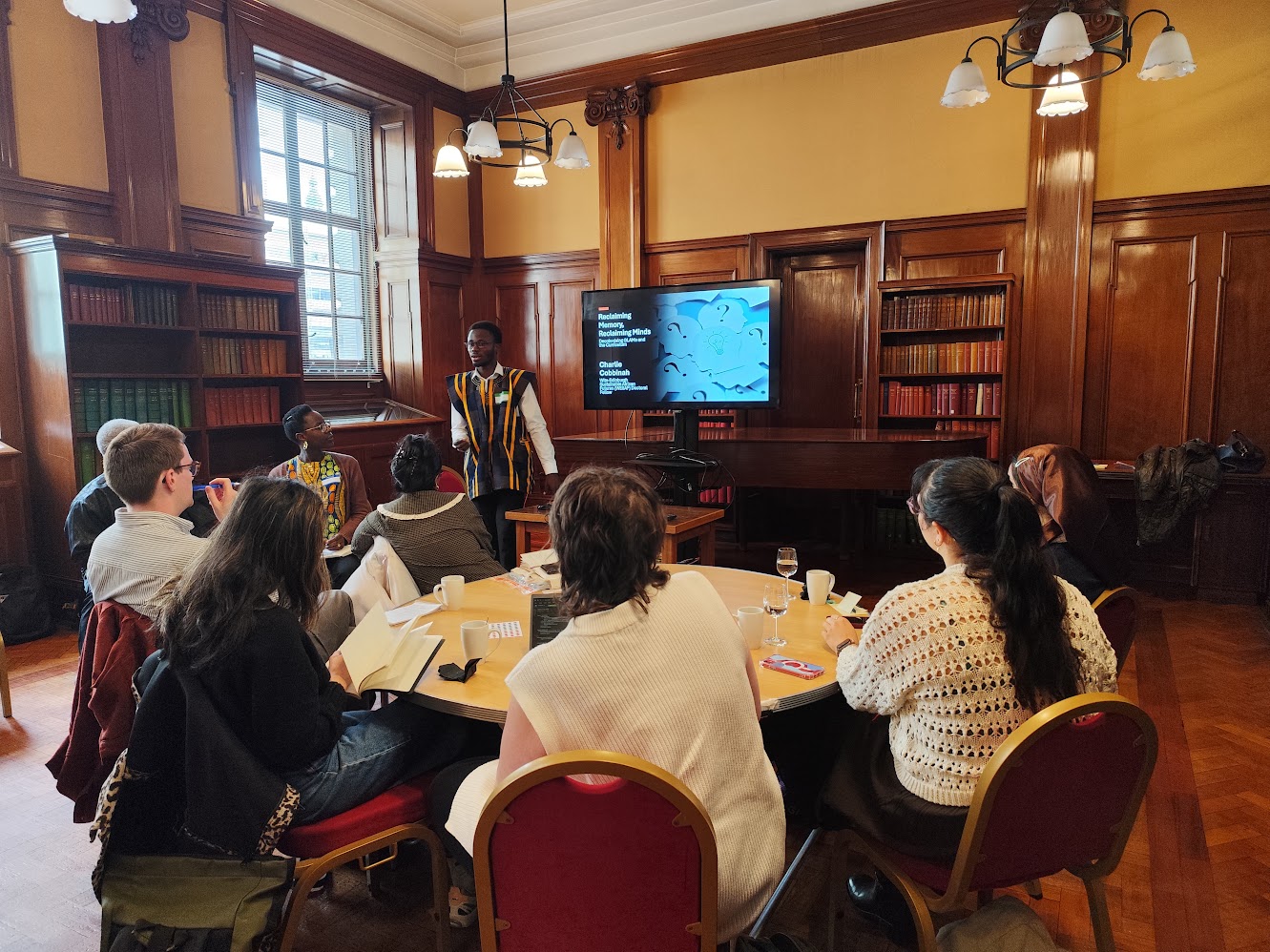
In May 2025, I was invited to present at the DeCoGLAM launch event at the University of Strathclyde, a gathering of researchers, archivists, and educators working at the intersection of decolonisation and cultural heritage institutions. My talk focused on a question that sits at the heart of decolonial pedagogy: when we teach through primary sources, whose story are we actually telling?
Primary sources carry an aura of authority. A colonial dispatch, a missionary journal, a census record: these feel like windows onto the past. But windows are not neutral. They frame. They exclude. They are built by hands with particular interests, in particular historical moments, for particular audiences. The document that survives in the archive is not simply the one that existed. It is the one that was deemed worth preserving.
The Archive as a Site of Power
The historian Achille Mbembe has written that the archive is not simply a building or a collection: it is a form of power. To control what enters the archive is to control what becomes history. Colonial administrations understood this well. The records they kept were designed to serve administrative purposes such as taxation, land appropriation, and labour control. The knowledge systems of colonised peoples, oral, embodied, and relational, were systematically excluded, not because they lacked rigour, but because they could not be easily captured, catalogued, or controlled.
The archive is first the law of what can be said, the system that governs the appearance of statements as unique events.
— Michel Foucault, The Archaeology of Knowledge
This has direct consequences for the classroom. When African history is taught primarily through European primary sources, explorer accounts, missionary records, and colonial dispatches, students are not simply learning history. They are being trained to see Africa through a particular lens, one that positions African peoples as objects of study rather than subjects of their own stories.
What Critical Analysis Demands
To decolonise the curriculum is not to discard European primary sources entirely. That would be its own distortion. These documents are part of the historical record and must be engaged with honestly. But critical analysis demands that we ask different questions of them.
Who wrote this document, and why? What were their assumptions? What did they choose not to record? Who is described in this text, and how, as agents, or as objects? What voices are absent, and why might that be? These are not merely methodological questions. They are ethical ones.
Alongside this critical reading of existing sources, decolonised curricula must actively seek out what the archive has marginalised. This means taking seriously oral traditions, community histories, and indigenous knowledge systems, not as supplements to the “real” historical record, but as archives in their own right, with their own epistemological integrity.
The Classroom as a Decolonial Space
I grew up in Ghana absorbing a version of history that felt disconnected from the world around me. The names, the events, the frameworks of causation, they were someone else’s. It took years of postgraduate study before I could name that disconnection, and longer still to begin imagining what a different kind of education might look like.
That imagining is not a luxury. For students across Africa and the African diaspora, the question of whose story is told in the classroom is not abstract. It shapes how they understand themselves, their communities, and their place in the world. A curriculum that consistently positions their histories as peripheral, their knowledge systems as pre-modern, and their intellectual traditions as invisible is doing active harm, however unintentionally.
Decolonising the curriculum, then, is not about replacing one set of stories with another. It is about expanding what counts as knowledge, who counts as a knower, and what kinds of sources and methods are granted legitimacy in the educational space. It is, ultimately, about building classrooms where all students can see themselves, not as the objects of history, but as its subjects.